



















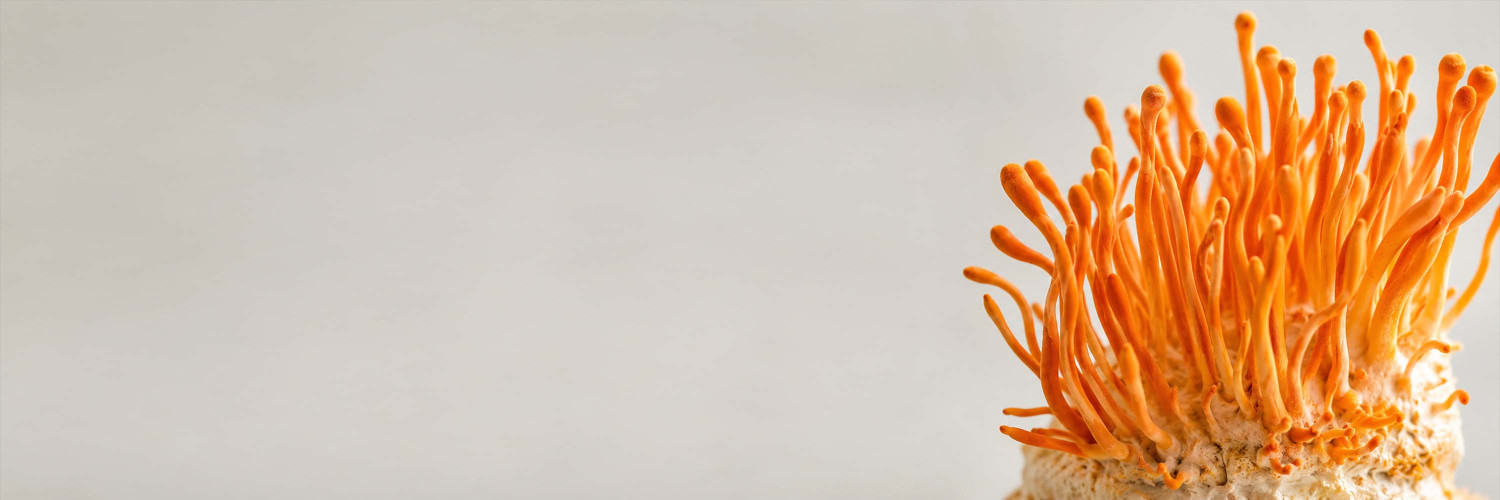
Cordyceps is the stamina mushroom — and the one where it matters most to be precise about species. The legend belongs to a rare wild fungus of the Himalayan plateau; the extract in a modern capsule is almost always a cultivated relative grown in clean conditions. We use cultivated Cordyceps militaris, the bright orange, club-shaped species you see above. This article explains the difference honestly, what cordycepin actually is, and what the human research on energy and endurance shows.
Botanical Characteristics
Cordyceps does not look like a mushroom at all. Instead of a cap and stem it forms slender, upright clubs — in C. militaris, a vivid orange, a few centimetres tall, with a slightly granular surface where the spores develop. It is an entomopathogenic fungus, meaning that in nature it grows from insect larvae. In cultivation that role is filled by a sterile grain or soy substrate, so what reaches the extract is purely the fungal fruiting body.
Two Species, One Name
Almost everything romantic ever written about Cordyceps refers to Ophiocordyceps sinensis — the wild "caterpillar fungus" of Tibet, Nepal and western China, which grows from the larvae of ghost moths at high altitude. It is one of the most expensive natural products on earth, is now under conservation pressure, and cannot be cultivated commercially at scale.
Cordyceps militaris is its widespread temperate cousin, found across Europe, Asia and North America, and it grows readily in cultivation. Crucially, it is the richer natural source of cordycepin, the signature molecule most associated with the genus. That is why serious modern supplements — ours included — are made from cultivated C. militaris: it delivers the characteristic compounds reliably, traceably and without touching a protected wild species. When you see Cordyceps sold cheaply as "sinensis," it is worth asking what is actually in the jar.
Chemical Composition
The compound that defines Cordyceps is cordycepin (3′-deoxyadenosine), a nucleoside analogue structurally close to adenosine — the same molecular family the body uses for cellular energy signalling. Alongside it sit adenosine itself, immune-active polysaccharides and beta-glucans, mannitol (cordycepic acid), sterols and carotenoid pigments, which give C. militaris its orange colour. Our extract is made from cultivated fruiting bodies and standardised to 30% polysaccharides.
Habitat
Cordyceps militaris occurs naturally in temperate woodland and grassland across the Northern Hemisphere, fruiting from buried insect pupae in soil and leaf litter — a far less exotic setting than the Himalayan plateau of its famous relative. Today it is cultivated indoors on sterile substrate in controlled light and humidity, which is what makes a consistent, contaminant-tested product possible.
Taste
Cordyceps has a mild, faintly sweet and nutty flavour with a subtle savoury note — considerably gentler than Reishi's bitterness. In China and Korea the orange clubs are simmered into broths and teas, and they are sometimes used simply as a colourful culinary garnish.
History of Use
Tibetan and Chinese texts have described the wild caterpillar fungus for centuries, and the traditional account is a memorable one: herders on the plateau noticed their yaks became notably more vigorous after grazing where the fungus grew. It entered mainstream sporting conversation in 1993, when a group of Chinese distance runners set world records and their coach credited a Cordyceps-based tonic — a story that did more for the mushroom's reputation than any laboratory ever has. Cultivation of C. militaris is far more recent, and is what turned a rare mountain curiosity into something anyone can take daily.

Cordyceps (Cordyceps militaris) Extract Benefits:
- Energy, Stamina & Endurance
- Respiratory Function & Oxygen Utilisation
- Immune System
- Antioxidant Support
Cordyceps is one of the twelve mushrooms in our Dozen Synergy Power™ blend, where it is the stamina and vitality component.
Cordyceps and Energy, Stamina and Endurance
This is the claim Cordyceps is built on, and it has real human trials behind it. In a randomized, placebo-controlled study, a Cordyceps militaris-containing formulation improved VO₂max and time to exhaustion during high-intensity exercise, with benefits growing over three weeks of supplementation.1 In a separate double-blind, placebo-controlled trial in healthy older adults, a fermented Cordyceps product raised the metabolic and ventilatory thresholds — the intensity at which exercise starts to feel hard — suggesting better exercise tolerance rather than raw power.2
A 2025 systematic review and meta-analysis of fungal supplements in athletes pooled 14 randomized trials and found Cordyceps associated with significant improvements in endurance performance, ventilatory threshold and VO₂peak.3 One nuance worth knowing: most of those trials used C. sinensis fermentation products rather than C. militaris, so the endurance evidence base is stronger for the genus than for any single species.
The mechanism appears to be about energy supply rather than masking tiredness. In mice, Cordyceps militaris extract improved exercise performance by upregulating the ATP generation pathway — raising AMPK, ATP, GLUT4 and phosphocreatine — rather than by reducing fatigue markers such as lactate dehydrogenase.4 That fits the traditional description of Cordyceps as something that builds capacity over weeks, not a stimulant that borrows energy from tomorrow.
Cordyceps and Immune Function Support
Cordyceps has been tested in healthy people for immune effects too. In a randomized, double-blind, placebo-controlled trial, 40 healthy adults aged 25–60 drank a fermented Cordyceps militaris beverage supplying 2.85 mg of cordycepin daily for eight weeks. Natural killer cell activity rose significantly in both men and women — by roughly a third from baseline in the male group — while inflammatory signalling markers including IL-1β, IL-6 and TNF-α decreased.5 Blood sugar, lipid and safety indices stayed within normal ranges throughout, with no adverse events reported.5
A Note on the Evidence
Cordyceps is among the better-supported functional mushrooms for exercise capacity, with several controlled human trials pointing the same way and a plausible energy-production mechanism behind them. The authors of the 2025 meta-analysis are candid about the field's limits — the trials are small, formulations differ widely between studies, and positive results may be over-represented in the literature.3 We offer Cordyceps as what that supports: a well-studied mushroom for helping maintain everyday energy, stamina and normal immune function, taken consistently — not an overnight performance fix.
How to Use Cordyceps Extract
- Dosage: As a dietary supplement, take 2–3 capsules daily.
- Timing: Any time of day. Many people prefer the morning or before training, since Cordyceps is the most energising mushroom in the range — the natural counterpart to taking Reishi in the evening.
- With meals: Taking the capsules with food supports absorption and minimises any digestive discomfort.
- Consistency: In the trials above benefits accrued over three to eight weeks of daily use, so treat it as a training block rather than a pre-workout.
- Storage: Keep in a cool, dry place away from direct sunlight to preserve potency.
Contraindications
- Allergies: Avoid if you have a known allergy to mushrooms.
- Pregnancy and breastfeeding: Consult your healthcare provider before use.
- Medications: If you take immunosuppressants, anticoagulants (blood thinners) or medication for diabetes, consult your doctor before adding this extract to your regimen.
- Competitive athletes: If you compete under anti-doping rules, check any supplement with your governing body before use.
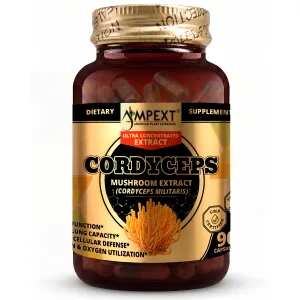
FROM THE AMPEXT RANGE
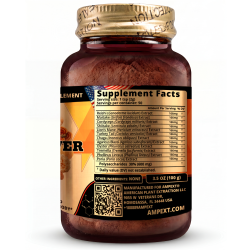
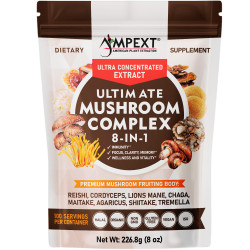
Cordyceps (Cordyceps militaris) Mushroom Extract, 90ct
Cultivated fruiting bodies · standardised to 30% polysaccharides · 90 vegetarian capsules
References
- Cordyceps militaris improves tolerance to high-intensity exercise after acute and chronic supplementation. Journal of Dietary Supplements, 2017.
- Effect of Cs-4 (Cordyceps sinensis) on exercise performance in healthy older subjects: a double-blind, placebo-controlled trial. Journal of Alternative and Complementary Medicine, 2010.
- Effects of fungal supplementation on endurance, immune function, and hematological profiles in adult athletes: a systematic review and meta-analysis. Frontiers in Nutrition, 2025.
- Beneficial effect of Cordyceps militaris on exercise performance via promoting cellular energy production. Mycobiology, 2020.
- A randomized controlled clinical trial examining the effects of Cordyceps militaris beverage on the immune response in healthy adults. Scientific Reports, 2024.
These statements have not been evaluated by the Food and Drug Administration. This product is not intended to diagnose, treat, cure or prevent any disease. The information in this article is provided for educational purposes only and is not medical advice; consult a qualified healthcare provider before starting any new supplement, especially if you are pregnant, nursing, taking medication, or have an underlying health condition.
Related Products
Leave a comment