
























Pick up almost any herbal supplement sold on a US marketplace, turn it over, and you will find a company name and an American address. What you will very often not find is the one fact you were probably looking for: where the product was actually made. That absence is not an oversight or a loophole being abused — it is exactly what the labelling rules permit. This article explains what a supplement label is legally required to tell you, shows what the wholesale market behind those labels actually looks like, and sets out why a US-made bottle costs what it costs. It is written by a US manufacturer, so read it with that in mind — but every factual claim here is sourced, and the uncomfortable ones about our own side are included too.
What a Supplement Label Must Actually Tell You
Under FDA rules, a dietary supplement label must carry five things: the statement of identity, the net quantity of contents, the Supplement Facts panel, the ingredient list, and the name and place of business of the manufacturer, packer, or distributor.1 That last "or" is the whole story. A company that never touched the product — that ordered it finished, labelled and boxed from an overseas factory — satisfies the requirement completely by printing its own name and a US address.
Country of origin is a separate matter, and it is not FDA's. A statement of origin is not required by the Federal Food, Drug, and Cosmetic Act; it falls under US Customs and Border Protection through the Tariff Act of 1930.2 Customs law does require that imported articles be marked with their country of origin — but the marking may sit on the article or its container.3
Put those two rules together and you get the everyday result: the retail label you actually read can legally show nothing but a US distributor's name and city. "Distributed by Wellness Brands LLC, Denver, CO" is a complete, lawful label. It tells you who sells it. It tells you nothing about who made it, or on which continent.
What Two Dollars Buys: The Market Behind the Label
To see what sits upstream of those labels, you do not need an investigator — the wholesale market is a public website. Below are listings we pulled from Alibaba, filtered to the US market. These are ordinary, legal offers from suppliers doing nothing wrong; we show them because the numbers explain the shelf better than any argument could.
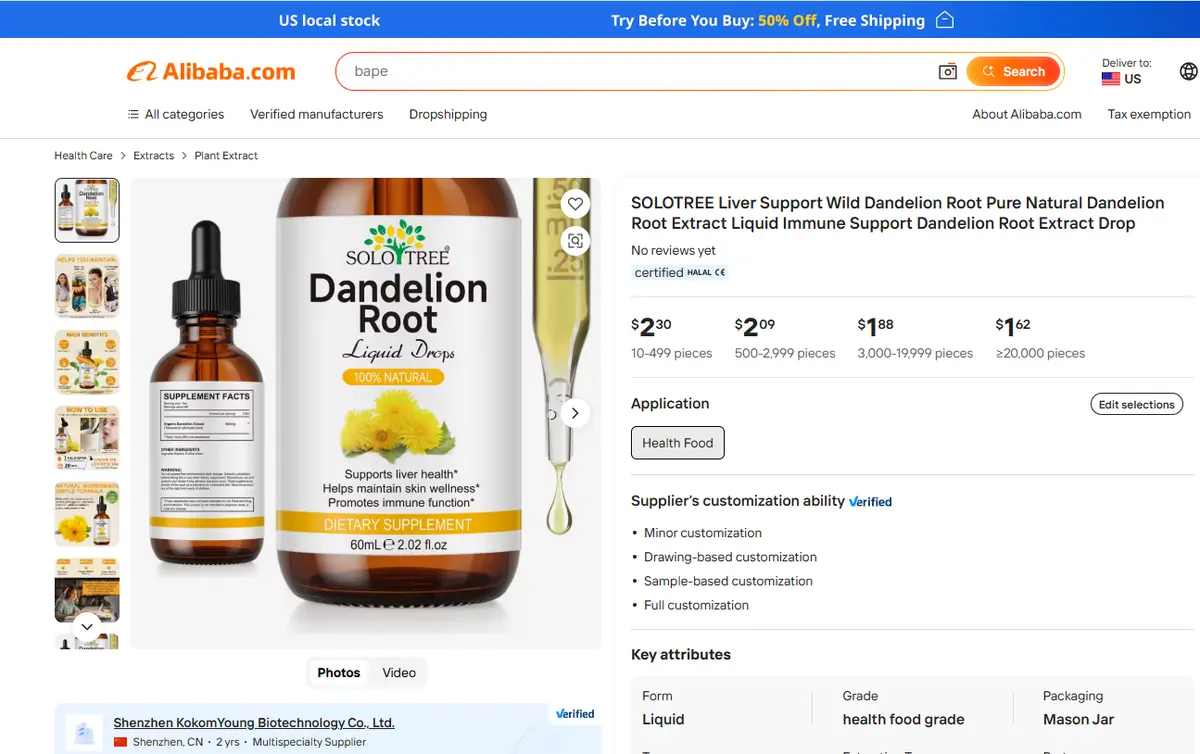
That is not an outlier. Here is the same category we work in ourselves — an alcohol-free mullein leaf liquid, 2 fl.oz, offered explicitly as OEM:
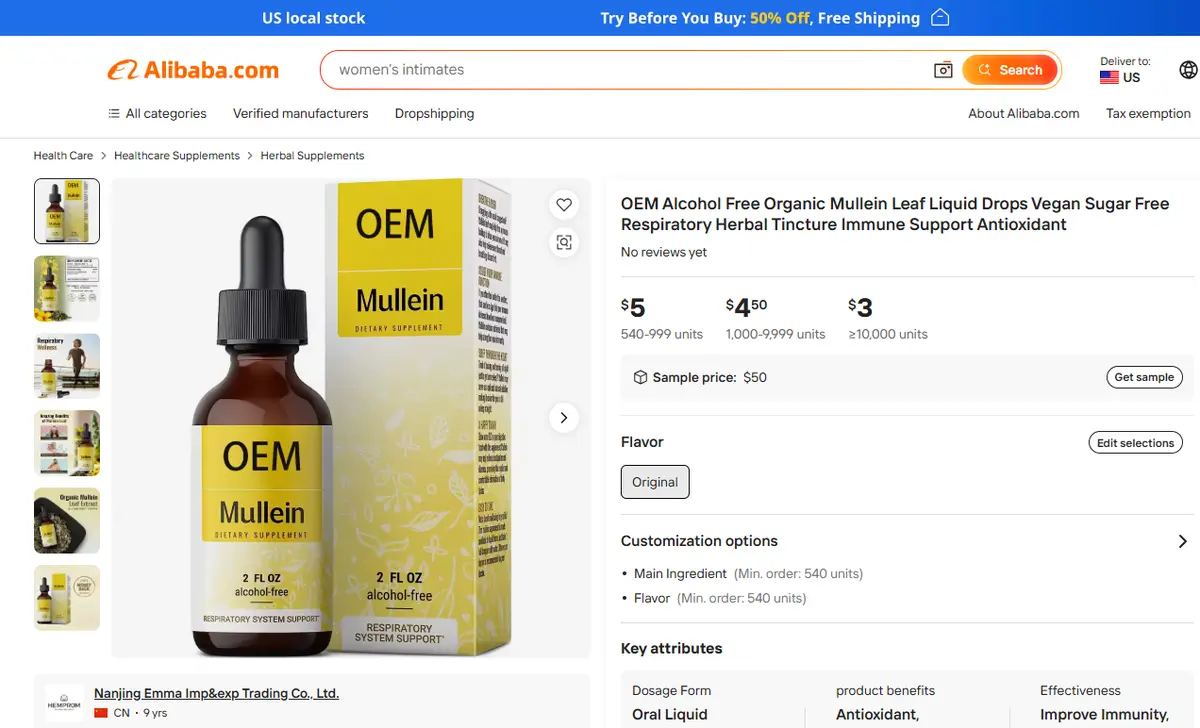
The clearest picture of how the business works comes from the factories that advertise the service directly:
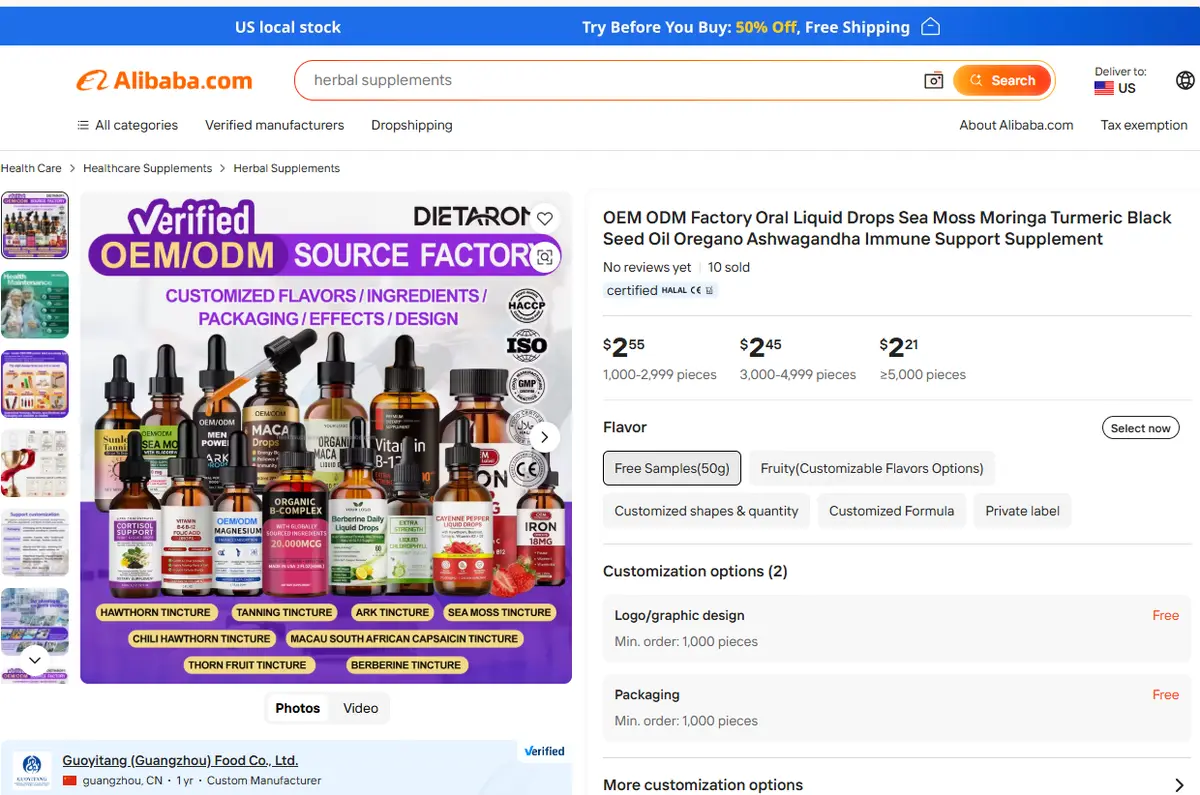
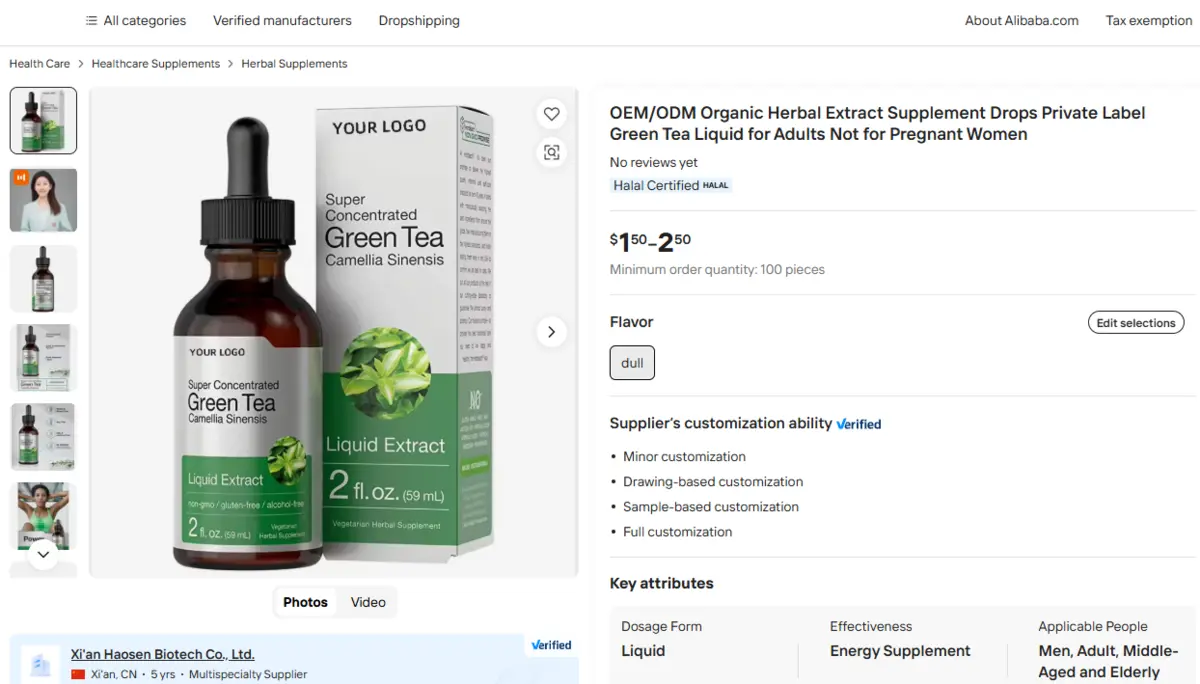
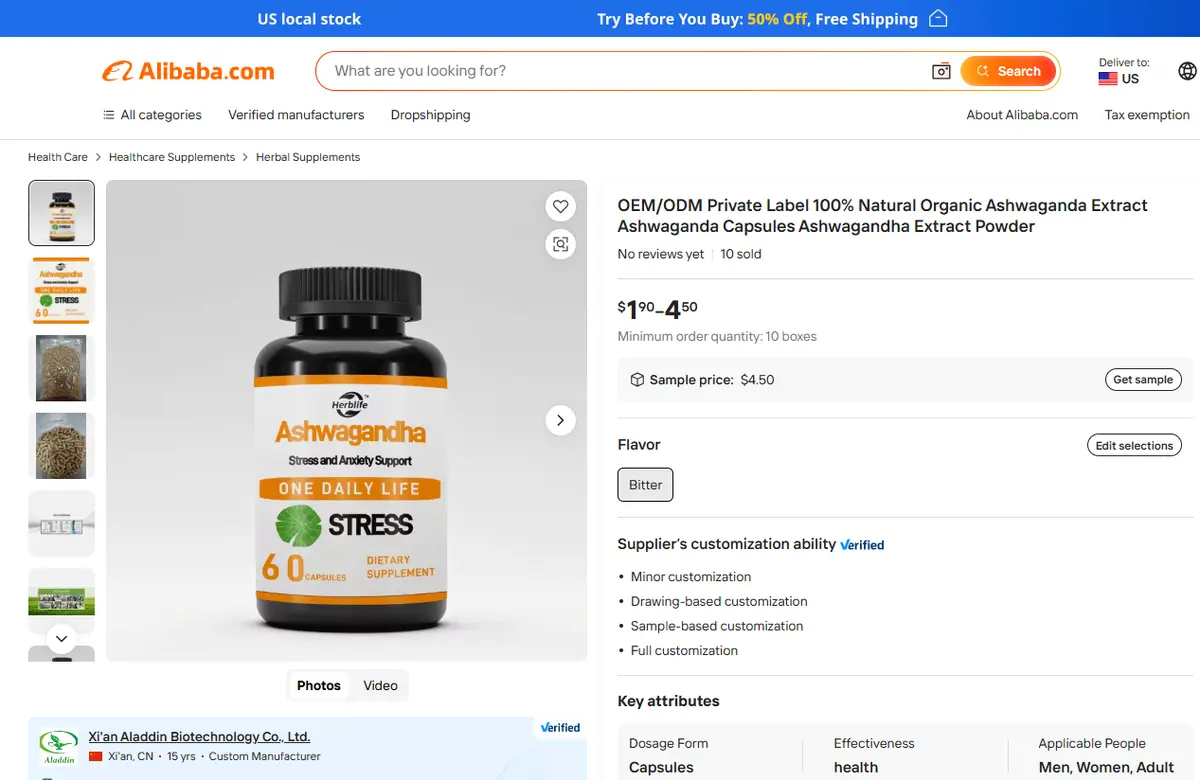
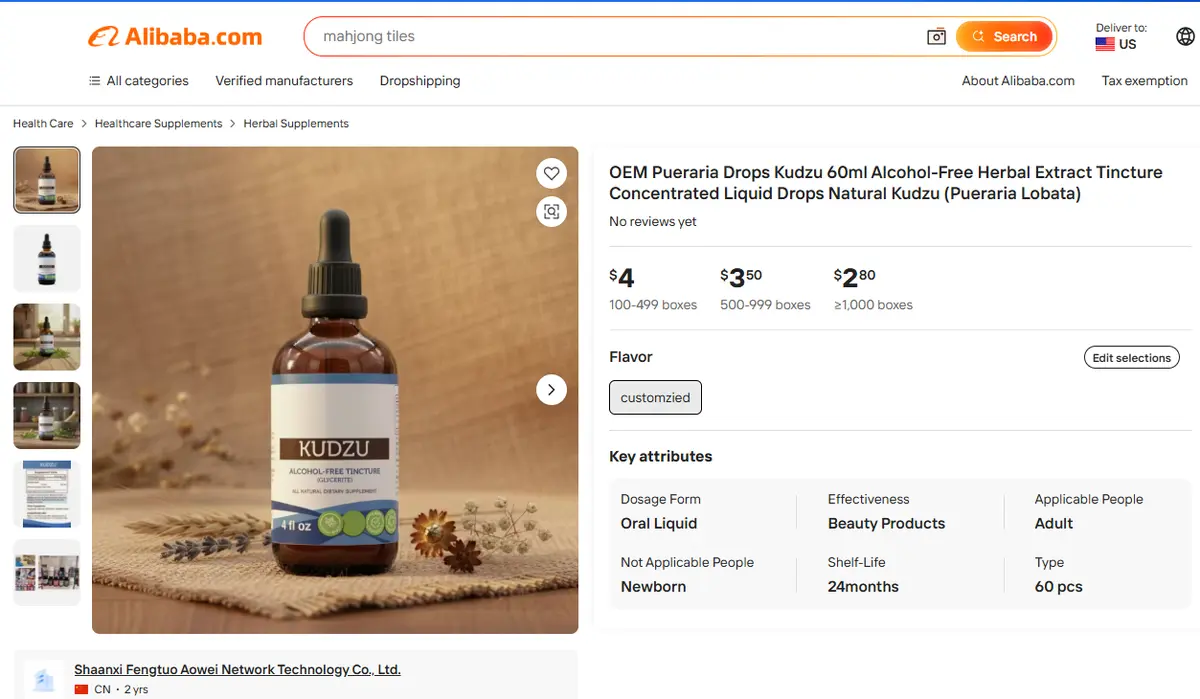
These same categories retail on US marketplaces for roughly $20–$25. That gap is not automatically scandalous — importing, storing, marketing and returns all cost money, and a seller is entitled to a margin. But it is worth knowing that the gap exists, and how wide it is.
How a Brand Gets Built in an Afternoon
The mechanics are genuinely this simple, and there is nothing illegal about any step:
- Choose a finished product from a catalogue of hundreds.
- Send your logo. Label and carton design are often free above a modest order quantity.
- The factory prints your brand on the bottle and ships the pallet directly to the marketplace's own fulfilment warehouse.
- You need a marketplace seller account. That is the entire infrastructure — no facility, no equipment, no staff, no inventory ever passing through your hands.
At a minimum order of 100 units and roughly $2 apiece, the cost of entry is a couple of hundred dollars. When something is that frictionless, it scales — which is precisely why these products now fill the category.
The GMP Rule That Landed on the Wrong People
In 2026 Amazon extended a requirement to every dietary supplement on its US marketplace: compliance with cGMP must be verified by an approved third-party certification body, with listings suppressed or removed for non-compliance.4
The intent is sound. We should say plainly that we are not neutral here: AMPEXT is itself certified to cGMP under 21 CFR Part 111 by SGS, so the rule is one we already meet. But look again at the third screenshot above — the GMP badge sits right there in the factory's advertising banner. Large overseas contract manufacturers producing by the tonne have held these certifications for years, and the cost of an audit is trivial against their volume.
For a small American producer making micro-batches, the same certification is a serious expense against a far smaller output. A rule written to raise quality can, in practice, fall hardest on the smallest domestic makers while barely touching the industrial-scale suppliers abroad. That is our reading of the effect, not a claim about anyone's intent — but the shelf is the evidence.
Who Actually Pays the Tariffs
There is a widespread assumption that a tariff on Chinese goods is paid by China. It is worth being precise about this, because it is not a matter of economic interpretation — it is a matter of who receives the invoice.
A tariff is a customs duty assessed at the border on the importer of record. When we bring in a shipment of empty glass bottles, US Customs and Border Protection bills us, and we pay that money to the US government. Our supplier in China is not party to the transaction, does not receive the bill, and it never appears anywhere in his accounts. From his side, nothing about the sale has changed at all. From ours, the landed cost of a bottle went up — and that increase flows straight into what a finished bottle of extract has to sell for.
The same applies to our vegetable glycerin, which is flaxseed-based and comes from India: price, plus freight, plus the duty we pay on arrival. There is no comparable domestic supply of either input at our scale, so there is nothing to switch to.
This is not just our experience. Economic research on the 2018–2019 US tariffs found the same thing across the economy: the costs were borne almost entirely by US firms and consumers, with close to complete pass-through into domestic prices, rather than being absorbed by foreign exporters.5
Now put the two sides next to each other. We import raw materials — glass, glycerin — and pay duty on each of them before we have made anything. A competitor importing finished, labelled bottles crosses that border once, at a single declared value, with no domestic wage, rent or testing cost behind it. A policy framed as protecting American manufacturing can, for a small American manufacturer buying inputs the country does not produce, work out close to backwards.
What We Found When We Ordered Samples
We buy competitor products periodically to see what the market is doing. Recently we ordered a number of alcohol-free liquid extract samples directly from overseas suppliers of the type shown above, and put them on the same instrument we use to identify every botanical raw material that arrives at our own facility: an FTIR spectrometer.
→ The instruments in our laboratory and how we use them
Fourier-transform infrared spectroscopy is well suited to exactly this question. Every compound absorbs infrared light in a pattern determined by its molecular bonds, so a sample produces a spectrum that functions as a chemical fingerprint. Glycerin and propylene glycol are both clear, syrupy polyols that look and pour much alike — but their spectra are plainly different, and telling them apart is routine rather than borderline.
In some of those samples, the base solvent returned propylene glycol, while the label stated vegetable glycerin. Those are not interchangeable materials: glycerin is a sweet, viscous polyol widely used as a food-grade solvent, and propylene glycol is a different, cheaper synthetic one. Someone buying a glycerite is usually buying it precisely to avoid alcohol and to get glycerin — so the label was describing a product the bottle did not contain. We also had reservations about the botanical identity of some of the plant material, but identity work on a finished extract is harder than identifying a solvent, and we are not going to state anything we cannot stand behind.
Three limits belong with that finding, and we would rather state them ourselves. It was a small number of samples, not a survey — it says nothing about the prevalence of the problem across the market. It concerns products we bought directly from suppliers, and we are not attributing it to any marketplace listing, retailer or brand. And it has no connection to the six suppliers pictured above, who are shown purely to illustrate how the wholesale market is structured and against whom we allege nothing whatsoever.
What the finding does illustrate is narrow and, we think, fair: when you cannot tell who made something, you are relying entirely on the honesty of a supply chain you cannot see.
Why a US-Made Bottle Costs More
It is not sentiment and it is not greed. The price difference is a list of line items:
- Identity testing on every incoming botanical, plus heavy-metals and microbiological analysis — instruments, reagents and analysts, or fees to an accredited outside laboratory.
- Documented quality systems — specifications, master manufacturing records, batch records, retained samples, and the third-party audit that verifies them.
- US wages, payroll taxes, insurance, rent and utilities.
- Imported raw materials with tariffs on top, as above.
- Domestic freight and fuel, at US rates.
None of that is visible in the bottle. All of it is in the price. A buyer is entitled to decide it is not worth the difference — that is a legitimate choice, and we would rather they make it knowingly than be told a story about it.
What We Are Not Saying
We are not saying products made in China are bad. That would be both unfair and untrue. China has outstanding manufacturing facilities, some far larger and better equipped than ours, producing excellent products to demanding specifications — and a great deal of the world's supplement raw material passes through them regardless of where the final bottle is filled. Origin is not a proxy for quality.
What we are saying is narrower: you have a right to know what country your supplement was made in, and who made it. Right now, on most labels, you cannot find out. That is the part we think is wrong.
And one practical consequence follows honestly from it: if you are content with imported supplements — and the packaging is genuinely attractive, the cartons and foil labels often nicer than ours — then you can buy them directly from the same wholesale sites for a fraction of the marketplace price. You would simply be removing a middleman. We would rather say that out loud than pretend the option does not exist.
How to Check Before You Buy
- Look for an explicit origin statement. "Made in the USA", or at minimum "manufactured", "bottled" or "packaged in the USA". If it is absent, absence is your answer.
- Do not read a US address as an origin claim. "Distributed by" means exactly what it says.
- Ask the seller directly where it is manufactured and which facility. A real manufacturer answers immediately; a reseller often cannot.
- Ask whether identity testing is done on incoming raw material, and by what method.
- Check whether cGMP compliance is certified and by whom, and ask for the certificate number.
- Read the "other ingredients" line and check the solvent base of any liquid extract is what you expect.
- Compare against the wholesale price. If a product retails at ten times what the same item costs finished and labelled at wholesale, that gap is buying you something — make sure you know what.
A Note on This Article
We are a US manufacturer writing about our own competitive situation, which is a conflict of interest we would rather name than have you notice. So: the labelling rules, the tariff research and the marketplace policy above are all cited and independently checkable. The wholesale listings are public and reproducible in a browser in about a minute. The sample finding is our own, limited, and flagged as such. And the conclusion we draw — buy imported supplements if you want, just buy them knowingly, and cheaper — is not a conclusion that benefits us.
References
- Dietary Supplement Labeling Guide, Chapter I: General Dietary Supplement Labeling. U.S. Food and Drug Administration.
- CPG Sec. 560.200 — Country of Origin Labeling. U.S. Food and Drug Administration.
- 19 CFR Part 134 — Country of Origin Marking (under 19 U.S.C. §1304, Tariff Act of 1930). U.S. Customs and Border Protection.
- Amazon Will Require cGMP Verification for All Dietary Supplements. Nutraceuticals World, 2026.
- The Impact of the 2018 Trade War on U.S. Prices and Welfare. Journal of Economic Perspectives, 2019.
These statements have not been evaluated by the Food and Drug Administration. This article is provided for educational purposes only and is not medical, legal or financial advice. The wholesale listings shown are public offers reproduced for illustration; no allegation of any kind is made against the suppliers pictured. Regulatory requirements described here were accurate at the time of writing and may change — consult primary sources for current rules.
Leave a comment