





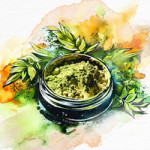
















Lion's Mane (Hericium erinaceus) is the mushroom people reach for when they want a clearer head. Its cascading white spines make it unmistakable in the forest, and its chemistry is just as distinctive: two families of compounds — hericenones and erinacines — that laboratory work links to nerve growth factor, the signalling protein neurons depend on. It is also a genuine delicacy, with a texture often compared to crab meat. This article looks at what is actually inside Lion's Mane, how it has been used, and what the research so far supports.
Botanical Characteristics
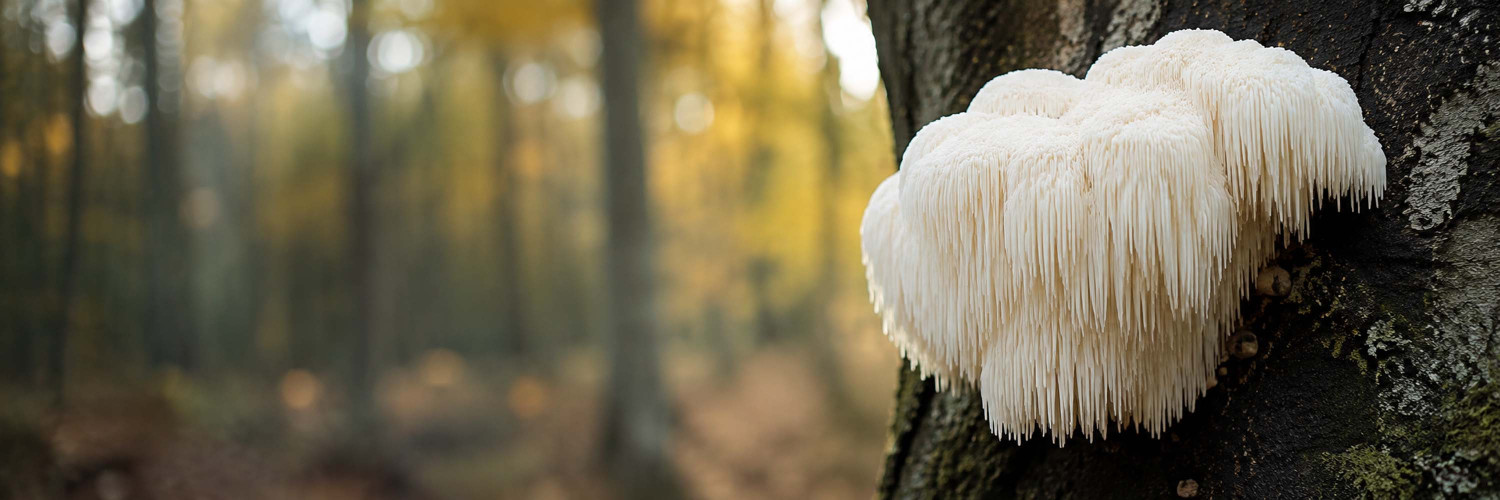
Lion's Mane is unlike any other functional mushroom to look at. Instead of a cap and gills it forms a rounded white cushion covered in long, soft, downward-hanging spines, like a frozen waterfall or a shaggy pompom. Young specimens are bright white, ageing to cream and pale yellow. It is a wood-decaying fungus that fruits from wounds and scars on standing hardwood trees, and it belongs to the tooth-fungus group, Hericium.
Chemical Composition
Two compound families define this mushroom. Hericenones are found in the fruiting body — the part we harvest and extract — while erinacines, cyathane diterpenoids, are concentrated in the mycelium. Both have been studied for their effect on nerve growth factor (NGF). Alongside them the mushroom supplies immune-active beta-glucans and other polysaccharides, ergosterol, antioxidant phenolics, and a range of B-vitamins and minerals. Our extract is made from the fruiting bodies and standardised to more than 30% polysaccharides, so the active fraction is present in a consistent, verifiable amount.
Habitat
Lion's Mane grows across North America, Europe and East Asia, favouring old hardwoods — beech, oak, maple and walnut. It appears late in the season, often high on a trunk where a branch has broken away. Because wild specimens are uncommon and short-lived, virtually all Lion's Mane used in food and supplements today is cultivated on hardwood sawdust.
Taste
Lion's Mane is a genuine culinary mushroom with a remarkable texture: when cooked, its fibrous spines pull apart into soft strands that are often compared to crab or lobster meat. The flavour is mild, faintly sweet and savoury, without the earthiness of many forest mushrooms.
History of Use
Known as yamabushitake in Japan — after the yamabushi mountain hermits whose garments its shaggy form was said to resemble — and as hóutóugū ("monkey head mushroom") in China, Lion's Mane has been eaten and used in East Asian traditional practice for centuries, associated with digestive comfort and vitality. Its modern reputation as a "brain mushroom" is much more recent, dating to Japanese laboratory work on nerve growth factor from the 1990s onward.

Lion's Mane (Hericium erinaceus) Extract Benefits:
- Nervous System & Cognitive Function
- Mood & Emotional Balance
- Digestive System
- Immune System
Lion's Mane is one of the twelve mushrooms in our Dozen Synergy Power™ blend, where it is the dedicated brain-and-focus component.
Lion's Mane and Nervous System Function Support
The interest in Lion's Mane begins with a specific laboratory observation. Extracts of the mushroom stimulate the production of nerve growth factor — a protein essential to the growth, maintenance and survival of neurons — in human astrocytoma cells, and hericenones were identified as the compounds responsible.1 This is laboratory work in cultured cells, and it is what first drew serious research attention to the mushroom.
The most cited human study is a Japanese double-blind, placebo-controlled trial in 30 men and women aged 50–80 with mild cognitive impairment. Over 16 weeks, the Lion's Mane group scored significantly higher on a cognitive function scale than placebo at weeks 8, 12 and 16, with no adverse effects in laboratory testing.2 Scores rose the longer participants took it and eased back in the weeks after they stopped — which is why Lion's Mane is best treated as a daily habit rather than an occasional pick-me-up.
In younger, healthy adults the research is still taking shape. A double-blind pilot study found participants completed a demanding attention task (the Stroop test) faster after a single dose, with a trend toward reduced subjective stress after 28 days.3 A 2025 crossover trial in 18 healthy young adults found a single 3 g dose improved manual dexterity but produced no overall change in cognition or mood, and its authors described the short-term picture as inconclusive.4 A 2025 systematic review of 26 studies summarised the field as showing real but modest and temporary cognitive benefit, limited so far by small samples and short trial durations.5 The sensible reading: a well-documented mechanism and encouraging results with sustained use, particularly in older adults.
Lion's Mane and Mood Support
A small randomized trial gave Lion's Mane to 30 women for four weeks and measured mood with standard questionnaires. Depression and anxiety scores were significantly lower after the intake period than before, with particular reductions in reported difficulty concentrating and irritability.6 The study is small and short, so it is best read as an early signal rather than a settled finding — but it fits the broader picture of a mushroom that supports a steady, balanced mental state rather than acting as a stimulant.
Lion's Mane and Digestive & Immune Function Support
Long before anyone spoke about Lion's Mane and the brain, East Asian tradition used it for digestive comfort — and its polysaccharides give that a plausible modern reading. In a laboratory study using digestive simulation and fermentation with fecal samples from healthy volunteers, Lion's Mane polysaccharides passed through simulated stomach and small-intestine conditions largely intact, reaching the distal gut where bacteria fermented them: short-chain fatty acid production rose and beneficial genera such as Bifidobacterium and Faecalibacterium increased.7 In other words, they behave like a prebiotic fibre.
That gut activity connects to immune function, since much of the body's immune tissue lines the intestine. In immunosuppressed mice, Lion's Mane polysaccharides improved immune-organ indices and shifted the gut microbiome back toward a healthy pattern, increasing short-chain-fatty-acid-producing bacteria.8 This is laboratory and animal research, and it offers a plausible modern explanation for the mushroom's long-standing digestive reputation.
A Note on the Evidence
Lion's Mane has a well-documented mechanism and a promising, still-growing body of human research — most of it small-scale, as is normal for functional foods. We offer it for what that research supports: a distinctive culinary mushroom that supports normal nervous-system and cognitive function as part of a consistent daily routine, not a treatment for any condition.
How to Use Lion's Mane Extract
- Dosage: As a dietary supplement, take 2–3 capsules daily.
- Timing: Best taken in the morning or early afternoon, at a consistent time each day.
- With meals: Taking the capsules with food supports absorption and minimises any digestive discomfort.
- Consistency: The one trial that tracked it found benefits built over weeks of continuous intake and receded after stopping — so regular, ongoing use makes more sense than occasional dosing.
- Storage: Keep in a cool, dry place away from direct sunlight to preserve potency.
Contraindications
- Allergies: Avoid if you have a known allergy to mushrooms.
- Tolerance: Occasional stomach discomfort or headache has been reported.5 If you are sensitive, start with a lower dose.
- Pregnancy and breastfeeding: Consult your healthcare provider before use.
- Medications: If you take immunosuppressants, anticoagulants (blood thinners) or medication for a neurological condition, consult your doctor before adding this extract to your regimen.
FROM THE AMPEXT RANGE
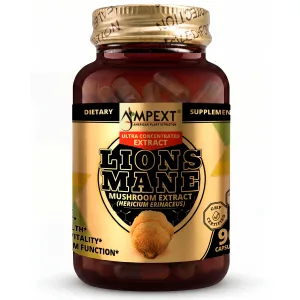
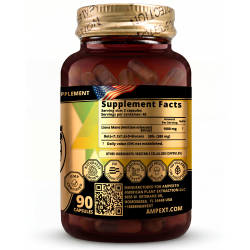
Lion’s Mane (Hericium erinaceus) Mushroom Extract, 90ct
Fruiting-body extract · standardised to 30% polysaccharides · 90 vegetarian capsules
References
- Nerve growth factor-inducing activity of Hericium erinaceus in 1321N1 human astrocytoma cells. Biological & Pharmaceutical Bulletin, 2008.
- Improving effects of the mushroom Yamabushitake (Hericium erinaceus) on mild cognitive impairment: a double-blind placebo-controlled clinical trial. Phytotherapy Research, 2009.
- The acute and chronic effects of Lion's Mane mushroom supplementation on cognitive function, stress and mood in young adults: a double-blind, parallel groups, pilot study. Nutrients, 2023.
- Acute effects of a standardised extract of Hericium erinaceus on cognition and mood in healthy younger adults: a double-blind randomised placebo-controlled study. Frontiers in Nutrition, 2025.
- Benefits, side effects, and uses of Hericium erinaceus as a supplement: a systematic review. Frontiers in Nutrition, 2025.
- Reduction of depression and anxiety by 4 weeks Hericium erinaceus intake. Biomedical Research, 2010.
- Digestive characteristics of Hericium erinaceus polysaccharides and their positive effects on fecal microbiota of volunteers during in vitro fermentation. Frontiers in Nutrition, 2022.
- Modulating effects of Hericium erinaceus polysaccharides on the immune response by regulating gut microbiota in cyclophosphamide-treated mice. Journal of the Science of Food and Agriculture, 2023.
These statements have not been evaluated by the Food and Drug Administration. This product is not intended to diagnose, treat, cure or prevent any disease. The information in this article is provided for educational purposes only and is not medical advice; consult a qualified healthcare provider before starting any new supplement, especially if you are pregnant, nursing, taking medication, or have an underlying health condition.
Related Products

Leave a comment