
















Reishi (Ganoderma lucidum) is the most storied mushroom in East Asian tradition — the lingzhi, once reserved for emperors and painted into scrolls as a symbol of long life. Its glossy, lacquered cap is unmistakable, and its chemistry is unusual among functional mushrooms: alongside the immune-active beta-glucans found across the group, Reishi carries a large family of bitter triterpenes known as ganoderic acids. This article looks at what is inside Reishi, why it has been valued for two thousand years, and what modern research supports.
Botanical Characteristics
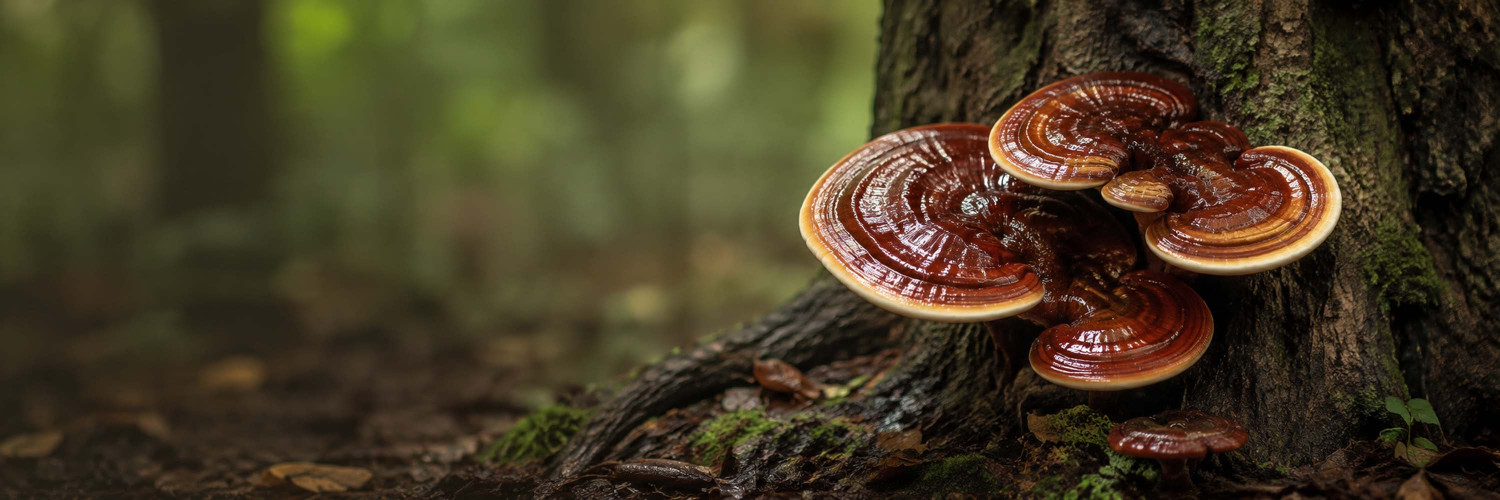
Reishi grows as a hard, woody bracket on the trunks and roots of hardwood trees. The cap is kidney- or fan-shaped and covered in a natural varnish-like layer that gives it a genuine shine — deep mahogany red at the centre, fading through amber to a pale cream rim at the actively growing edge, with fine concentric growth rings. Unlike culinary mushrooms it is tough and corky rather than fleshy, which is why it has always been prepared as a decoction or extract rather than eaten.
Chemical Composition
Two families of compounds define Reishi. The first is its polysaccharides, principally (1→3),(1→6)-beta-glucans, which interact with the innate immune system. The second is what makes Reishi distinctive: more than a hundred triterpenes of the lanostane type, dominated by the ganoderic acids and the related lucidenic acids. These triterpenes are responsible for the mushroom's pronounced bitterness, and a recent review catalogues the substantial research attention they have drawn for anti-inflammatory, hepatoprotective, antioxidant and neuroprotective activity.1 Reishi also supplies sterols, peptides and trace minerals. Our extract is standardised to more than 30% polysaccharides, so the active fraction is present in a consistent, verifiable amount.
Habitat
Reishi is native to East Asia and grows on hardwoods such as maple, oak and plum, usually at the base of the trunk or on exposed roots. In the wild it is genuinely uncommon — historically its rarity is exactly what made it precious and imperial. Today virtually all Reishi is cultivated on hardwood logs or supplemented sawdust, which makes a consistent, traceable supply possible.
Taste
Reishi is frankly bitter — a deep, woody bitterness that comes directly from its triterpene content. In traditional practice it is simmered for hours into a dark tea, and that bitterness has always been taken as a sign of potency rather than a fault. It is also the practical reason Reishi is taken as a concentrated extract in capsules instead of being cooked as food.
History of Use
Few natural products carry as much cultural weight. Chinese texts have described lingzhi — the "mushroom of spiritual potency" — for more than two thousand years, and it appears in the Shennong Ben Cao Jing among the highest class of remedies. Because wild specimens were so scarce, it was associated with emperors, longevity and good fortune, and its distinctive shape became a recurring motif in Chinese and Japanese art. In Japan it is reishi or mannentake, the "10,000-year mushroom."
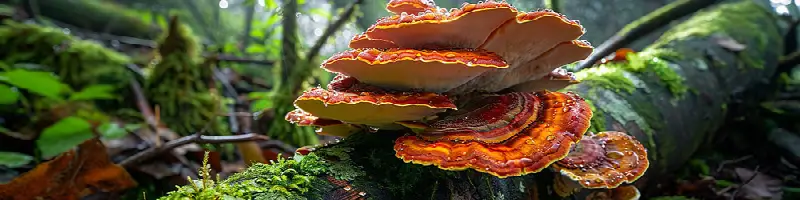
Reishi (Ganoderma lucidum) Extract Benefits:
- Immune System
- Calm, Mood & Stress Resilience
- Antioxidant Support
- Everyday Vitality
Reishi is one of the twelve mushrooms in our Dozen Synergy Power™ blend, where it is the grounding, balancing presence.
Reishi and Immune Function Support
Reishi has the distinction of being tested in one of the better-designed mushroom trials in healthy people. In a randomized, double-blind, placebo-controlled study, 135 healthy adults aged 18–55 took 200 mg of Reishi-derived beta-1,3;1,6-D-glucan daily for 84 days. Compared with placebo, the Reishi group showed significantly higher CD3+, CD4+ and CD8+ T-lymphocyte counts, an improved CD4/CD8 ratio, higher natural killer cell counts and markedly greater NK cell cytotoxicity, along with elevated serum IgA — the antibody that guards mucosal surfaces such as the airways and gut.2
Two things make that trial particularly useful. It was conducted in ordinary healthy adults rather than patients, which is the population actually buying a daily supplement; and it tracked safety carefully, finding no meaningful change in liver enzymes, kidney markers or blood counts over the full twelve weeks.2 This is the clearest evidence behind Reishi's traditional reputation for supporting the body's everyday defences.
Reishi and Calm, Mood and Stress Resilience
Reishi has always been classed in traditional practice as a calming, grounding tonic rather than a stimulant — the mushroom you take in the evening. Modern work gives that a partial modern reading. In a placebo-controlled trial in women living with fibromyalgia, Reishi supplementation was associated with within-group improvements in happiness and life satisfaction and a reduction in low mood.3
Animal research points to the triterpenes as a plausible route: in mice, Reishi triterpenoids reduced anxiety- and depression-like behaviours, an effect linked to calmer inflammatory signalling in the brain.4 Taken together, these are early findings rather than settled ones, but they align well with how Reishi has been used for centuries — as support for a steady, balanced state rather than a quick lift.
Reishi and Antioxidant Support
Oxidative stress is part of normal metabolism, and the body answers it with its own antioxidant enzymes. A 2025 meta-analysis pooling 17 randomized trials found that Reishi supplementation was associated with a measurable rise in glutathione peroxidase — one of the body's principal built-in antioxidant enzymes — alongside modest reductions in body mass index, resting heart rate and creatinine.5 Supporting the body's own defensive machinery, rather than simply adding antioxidants from outside, is the more interesting mechanism here.
A Note on the Evidence
Reishi is backed by a genuinely strong controlled trial on immune markers in healthy adults, a long and well-documented traditional record, and a rich, heavily studied triterpene chemistry. The wider clinical literature is still maturing: the 2025 meta-analysis rated the overall certainty of its pooled findings as low, since most of the underlying trials were small and varied in design.5 We offer Reishi as what that picture supports — a time-honoured mushroom that supports normal immune function, everyday calm and antioxidant defences as part of a consistent routine.
How to Use Reishi Extract
- Dosage: As a dietary supplement, take 2–3 capsules daily.
- Timing: Traditionally taken in the evening or before bed, since Reishi is valued as a calming rather than energising mushroom. It can equally be taken earlier in the day if that suits you better.
- With meals: Taking the capsules with food supports absorption and minimises any digestive discomfort.
- Consistency: The immune trial above ran for twelve weeks of daily intake — Reishi is a slow, cumulative supplement, not a one-off.
- Storage: Keep in a cool, dry place away from direct sunlight to preserve potency.
Contraindications
- Allergies: Avoid if you have a known allergy to mushrooms.
- Pregnancy and breastfeeding: Consult your healthcare provider before use.
- Medications: If you take immunosuppressants, anticoagulants (blood thinners), blood-pressure medication or medication for diabetes, consult your doctor before adding this extract to your regimen.
- Before surgery: As with other supplements that may affect clotting, discontinue use and inform your doctor ahead of scheduled surgery.
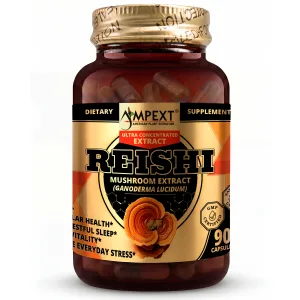
FROM THE AMPEXT RANGE
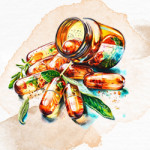
Reishi (Ganoderma lucidum) Mushroom Extract, 90ct
Standardised to 30% polysaccharides · 90 vegetarian capsules
References
- Research progress on the biological activity of ganoderic acids in Ganoderma lucidum over the last five years. Life (Basel), 2024.
- Evaluation of immune modulation by β-1,3; 1,6 D-glucan derived from Ganoderma lucidum in healthy adult volunteers: a randomized controlled trial. Foods, 2023.
- Ganoderma lucidum effects on mood and health-related quality of life in women with fibromyalgia. Healthcare, 2020.
- Ganoderma lucidum triterpenoids improve maternal separation-induced anxiety- and depression-like behaviors in mice. 2022.
- The nutritional significance of Ganoderma lucidum on human health: a GRADE-assessed systematic review and meta-analysis of clinical trials. Food Science & Nutrition, 2025.
These statements have not been evaluated by the Food and Drug Administration. This product is not intended to diagnose, treat, cure or prevent any disease. The information in this article is provided for educational purposes only and is not medical advice; consult a qualified healthcare provider before starting any new supplement, especially if you are pregnant, nursing, taking medication, or have an underlying health condition.
Related Products
Leave a comment