




















Jewelweed (Impatiens capensis) is the succulent, orange-flowered annual that North American folk tradition has reached for after a walk goes wrong — and, with a botanical sense of humour, it very often grows in the same damp ground as poison ivy. It is one of the few folk remedies to have been put to the test in controlled studies, and the results are genuinely interesting: they point to a mechanism nobody expected. This article covers what the plant is, what is actually in it, what the research found, and where a cooling spray honestly fits in.
Botanical Characteristics
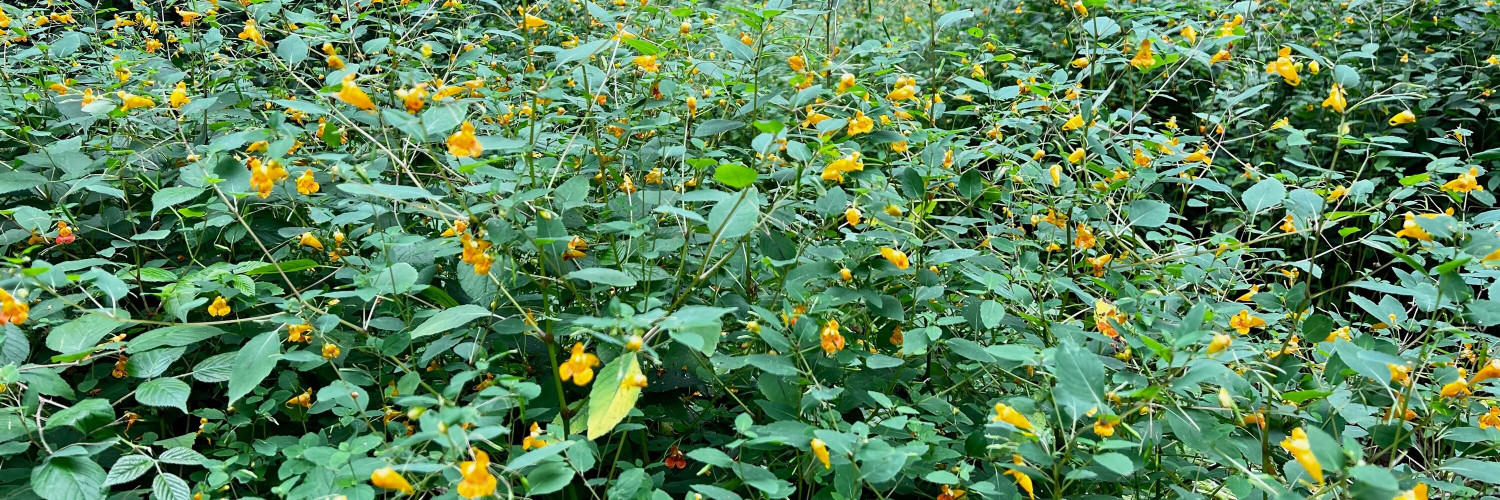
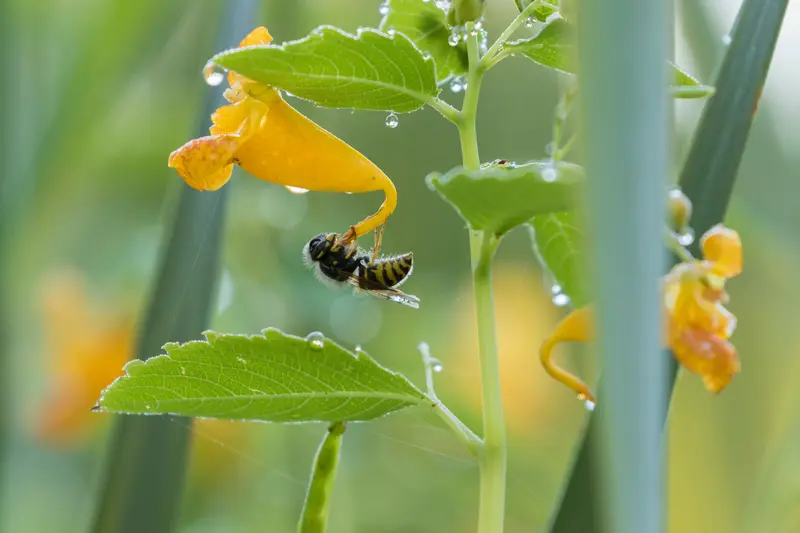
Jewelweed is a fast-growing annual reaching one to one and a half metres in a single season, with translucent, almost watery stems that snap easily and are noticeably swollen at the leaf nodes. The leaves are oval and softly toothed, blue-green above and paler beneath. From midsummer to frost it carries curious pendant flowers — orange, often freckled with reddish-brown spots, and shaped like a hooded cornucopia with a curled nectar spur at the back, hung from thin stalks so they nod at a touch. The seed capsules are the reason for its other common name, spotted touch-me-not: when ripe they are under tension, and the lightest brush makes them split and fling their seeds several feet. The species is also written as Impatiens biflora in older literature.
Chemical Composition
Two constituent groups matter here, and the research has been unusually clear about which one does the work. The plant contains saponins — natural glycosides with a genuinely soap-like character, which foam in water and act as surfactants — along with lawsone (2-hydroxy-1,4-naphthoquinone), the same orange pigment that gives henna its dye, plus flavonoids including kaempferol. For years lawsone was assumed to be the active principle. When it was tested directly, however, lawsone content did not track with the plant's traditional effect, while saponin content did.1 The interesting conclusion is that jewelweed's folk reputation appears to rest less on pharmacology than on chemistry of a much simpler kind — the plant carries its own soap.
Habitat
Jewelweed is native to eastern and central North America, from Canada down to the Gulf states. It wants moisture and shade: stream banks, wet ditches, seepy woodland edges and the margins of ponds, where it often forms dense colonies. Its overlap with poison ivy is real rather than folklore — both favour disturbed, damp, partly shaded ground, so the two frequently grow within arm's reach of one another. Because the plant is soft, succulent and highly perishable, it does not dry or store well, which is why traditional use has always been immediate and fresh, and why our extract is made from fresh jewelweed rather than dried material.
History of Use
Jewelweed's record among Native American peoples of the eastern woodlands is long and consistent: the fresh stem was split or crushed and the juice applied directly to skin after contact with poison ivy, nettles or other irritating plants. Settlers adopted the practice quickly, and it passed into general North American field lore — the plant is still one of the first things taught in wilderness and scouting instruction, precisely because it is easy to identify and tends to grow where it is needed. That combination of accessibility and long use is what eventually prompted researchers to test it properly.
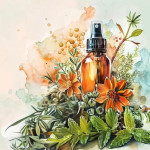
JewelIce™ Soothing Spray (Impatiens capensis) — What It's For:
- Immediate Cooling Sensation on Skin
- The Traditional Oak & Ivy Plant of North America
- Made from Fresh, Never Dried, Jewelweed
- Soothing After Insect Bites and Nettle Stings
- Fine-Mist Bottle Sized for a Daypack
For external use only — never taken by mouth. Alcohol-based, so keep it away from open flame.
Why It's Called Jewelweed
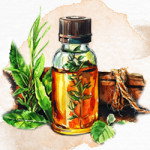
Two features earn the name, and both are worth seeing in person. The leaves carry a fine waxy bloom that makes water bead up and sit on the surface as bright silver droplets, so a colony after rain or heavy dew looks genuinely jewelled. And the flowers themselves hang like small orange pendants. The translucence of the stems is part of the same character — hold a cut stem to the light and it is almost glassy, full of the watery sap that traditional use depended on.
What the Research Actually Found
Jewelweed is one of the rare folk remedies with a real experimental record, and the honest summary is that the picture took three decades to come into focus. An early controlled trial applied a jewelweed extract to skin already reacting to urushiol — poison ivy's irritant resin — in a randomized, double-blinded design against a water control, and found no difference between them.2 Later work approached it from the other end, testing the fresh plant as a wash after exposure rather than as a treatment for an established reaction — and here the results were positive, with the crushed fresh plant showing a clear effect while isolated lawsone showed none.1 A follow-up study isolated the saponin fraction, tested it on volunteers' forearms, and found that both the saponin extracts and ordinary soaps worked, concluding that saponin content is what correlates with the effect.3
Put together, that is a tidy and rather satisfying answer: jewelweed's traditional benefit looks like the work of its natural surfactants helping lift the oily resin off skin, in the window before it binds. The practical lesson is simple and worth knowing on the trail — washing the area promptly is the step that removes the oil, and it is what the evidence supports. A cooling spray is for what comes after: the comfort of the skin that has already been through it.
The Cooling You Feel Is Real
The immediate sensation JewelIce delivers is not suggestion — it is one of the better-mapped mechanisms in sensory biology. Menthol activates TRPM8, the same ion channel in peripheral sensory nerve endings that responds to genuine cold, which is why menthol on skin reads to the brain as cooling even though nothing has changed temperature. That cooling pathway also dampens the sensation of itch: work in animals showed that cooling relieved both histamine-driven and non-histamine itch, and that the relief disappeared entirely in animals lacking TRPM8 neurons — establishing the channel as the route by which cool sensations quiet an itchy signal.4 That is animal research into mechanism rather than a trial of our spray, but it explains precisely why the cool hit of menthol is the most reliable comfort in the bottle, and why resisting the urge to scratch is easier once skin feels cold.
The Rest of the Blend
Each of the other botanicals is there for a plain reason. Witch hazel (Hamamelis virginiana) distillate is the classic North American skin astringent, valued for the tightening, freshening feel its tannins give. Peppermint (Mentha piperita) essential oil contributes its own natural menthol alongside the menthol crystals. Tea tree (Melaleuca alternifolia) essential oil brings the clean, resinous character it is known for in skincare. And the format matters more than it sounds: a fine mist lets you cover an area without touching it, then air dry, which is welcome when the last thing skin wants is more rubbing.
A Note on the Evidence
Jewelweed has a long, consistent traditional record and an unusually honest experimental one, which together point to its saponins and prompt washing rather than to a pharmacological effect on skin that is already reacting. Menthol's cooling action, by contrast, is well characterised. We offer JewelIce for what it genuinely is — an immediate, cooling, botanical comfort spray built around the traditional oak-and-ivy plant of North America — and we make no medical claims for it.
Using JewelIce Sensibly
This is a topical comfort spray, and using it well is mostly common sense. It is for external use only and is never taken by mouth. Mist it onto intact skin, let it air dry rather than wiping it off, and reapply every few hours when you want the cooling back. Keep it away from your eyes — if any gets in, rinse thoroughly with water. The formula is alcohol-based, which is what keeps a fresh-plant extract stable, so treat it as you would any alcohol-based spray and keep it away from open flame. If you have sensitive skin, a small patch test on the forearm first is a reasonable habit with any botanical blend containing essential oils. Stop using it if the skin becomes irritated, and if the area is getting worse rather than better, or is still bothering you after about a week, that is the point to see a practitioner rather than reach for another bottle.
How to Use JewelIce
- Wash first if you can: After suspected contact with poison ivy, oak or sumac, washing the area is the step that lifts the oil — then use the spray for comfort.
- Shake well: A quick shake before every use.
- Mist the area: Spray directly onto the affected skin from a few inches away.
- Let it air dry: Do not wipe it off, and try not to scratch.
- Reapply: Every 2–3 hours, or whenever you want the cooling sensation back.
- Storage: Cool and dark, or in the refrigerator for an extra-cold hit.
Contraindications
- External use only: Never swallow it; keep away from eyes and mucous membranes.
- Broken skin: Not for open wounds, weeping or badly broken skin.
- Sensitive skin: Contains essential oils and menthol — patch test first if you react easily.
- Flammable: Alcohol-based; keep away from open flame.
- Children: Keep out of reach of children.
- If it worsens: Stop use and consult a practitioner if the condition worsens or persists beyond about a week.
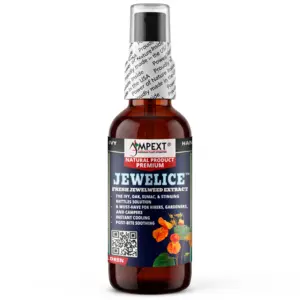
FROM THE AMPEXT RANGE
JewelIce™ Soothing Oak & Ivy Spray
Fresh jewelweed extract · menthol · witch hazel · tea tree · external use only · 2 oz
References
- The effectiveness of jewelweed, Impatiens capensis, the related cultivar I. balsamina and the component, lawsone in preventing post poison ivy exposure contact dermatitis. Journal of Ethnopharmacology, 2012.
- Treatment of poison ivy/oak allergic contact dermatitis with an extract of jewelweed. American Journal of Contact Dermatitis, 1997.
- Efficacy of the saponin component of Impatiens capensis Meerb. in preventing urushiol-induced contact dermatitis. Journal of Ethnopharmacology, 2015.
- Cooling Relief of Acute and Chronic Itch Requires TRPM8 Channels and Neurons. Journal of Investigative Dermatology, 2018.
These statements have not been evaluated by the Food and Drug Administration. This product is not intended to diagnose, treat, cure or prevent any disease. For external use only. The information in this article is provided for educational purposes only and is not medical advice; consult a qualified healthcare provider if you have a skin condition, are pregnant or nursing, or are unsure whether a topical product is right for you.
Related Products
Leave a comment