























Pau d'Arco is the inner bark of the pink trumpet tree (Tabebuia impetiginosa), a canopy giant of South America whose Portuguese name means simply "bow stick" — the wood indigenous peoples chose for their hunting bows. Known across its range as lapacho and, in Japan and Korea, as taheebo, its bark carries an unusual family of pigmented compounds called naphthoquinones. This article covers what the tree is, what the bark contains, its long place in South American practice, and an honest look at what the research does and does not show.
Botanical Characteristics
The pink trumpet tree is a large deciduous tree of the Bignoniaceae family, reaching 30 metres in forest conditions, with a straight trunk and hard, dense timber. Its most striking feature is its flowering habit: for a few weeks in late winter and spring the tree drops its leaves and covers itself in masses of trumpet-shaped flowers in vivid magenta-pink, a display so spectacular that the species is planted as a street tree across the subtropics. The leaves are palmately compound with five leaflets, and the fruit is a long, narrow capsule holding winged seeds. What is used is the inner bark — the living layer beneath the outer bark — which is cut and sifted for extraction. Botanists have moved the species between genera over the years, so you will also see it correctly written as Handroanthus impetiginosus, and in older literature as Tabebuia avellanedae.
Chemical Composition
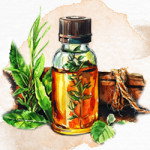
The bark's signature constituents are naphthoquinones — coloured, ring-structured compounds that plants use in their own chemical defences. The two best known are lapachol, named directly after the tree's local name lapacho, and β-lapachone.1 Alongside these sit anthraquinones, flavonoids, benzoic acid derivatives, iridoids and phenolic glycosides, giving the inner bark a genuinely complex profile rather than a single active compound.1 Naphthoquinones are a widespread plant motif — the same broad family gives henna its lawsone and walnut husks their pigment. Our extract is a full-spectrum glycerite of wildharvested inner bark in flaxseed vegetable glycerin, made by temperature-controlled maceration rather than from reconstituted powder.
Habitat
The tree is native to South and Central America, growing from Mexico south through Brazil, Bolivia, Paraguay and northern Argentina. It is a tree of seasonally dry forest, savanna woodland and the edges of the Amazon basin rather than of permanently swampy ground, and it tolerates poor soils well. Because the bark is the harvested part, sourcing matters: our bark is wildharvested, gathered from trees growing in their natural habitat, which is the traditional source and the one prized for mature botanical character.
Taste
Distinctly bitter, woody and astringent, with an earthy, faintly tea-like character — unsurprising for a bark whose traditional preparation was a long-simmered decoction. In a glycerin base the bitterness is noticeably rounded and softened by glycerin's natural sweetness, which is much of the appeal of an alcohol-free extract for a bark of this kind.
History of Use
Few South American trees have as long a documented record. The name says much of it: pau d'arco is Portuguese for "bow stick", and the tree's exceptionally hard, resilient wood was the material of choice for hunting bows among indigenous peoples of the Amazon and Paraná basins. The inner bark took a separate path, prepared as a simmered decoction or tea and used widely in local and traditional medicine across Central and South America — a bark valued for general wellbeing, for skin, and as a warming seasonal preparation.1 In the twentieth century the bark travelled: it became a staple herbal tea in Japan and Korea under the name taheebo, and reached North American and European herb shelves as lapacho or pau d'arco, where it remains one of the most widely traded South American barks.
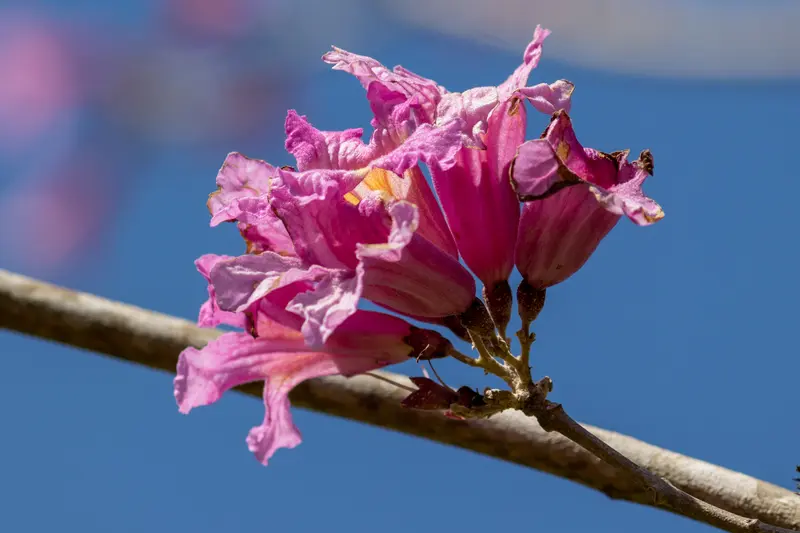
Pau d'Arco (Tabebuia impetiginosa) Glycerite — Traditional Uses:
- Classic South American Inner-Bark Tonic
- Naphthoquinone-Rich Wildharvested Bark
- Traditionally Valued for Everyday Comfort
- Supports the Body's Normal Inflammatory Response*
- Alcohol-Free, Naturally Rounded Taste
Alcohol-free and made with organic flaxseed glycerin. If you take prescription blood thinners, please read the note below first.
The Naphthoquinones Behind the Bark
Most of what makes pau d'arco chemically interesting comes back to its quinones. These are pigmented, reactive molecules that participate readily in the cell's own electron-transfer chemistry — which is precisely why they attract laboratory attention, and also why a whole-bark extract taken in modest amounts is a very different proposition from an isolated compound in a test tube. Lapachol is the compound the tree is best known for, and it is concentrated in the heartwood and inner bark rather than the leaves.1 It is worth keeping the scale in mind: a traditional decoction or a dropper of glycerite delivers a dilute, full-spectrum mixture, not a purified quinone.
Pau d'Arco and the Body's Inflammatory Response
This is where the bark's modern evidence is strongest, and it is consistent across several independent laboratories. A water extract of the inner bark — taheebo, essentially the traditional tea — was studied both in cell culture and in live animals, and was found to suppress the production of prostaglandin E2 and nitric oxide, two of the body's central signalling molecules in the inflammatory response, while also reducing expression of the enzymes that generate them.2 A separate group, working with an ethanolic bark extract in standard rodent pain and swelling models, reported a meaningful effect at 200 mg/kg — raising the pain threshold by roughly 30% and reducing swelling by 30–50%, with lower doses trending in the same direction without reaching statistical significance.3 These are animal and cell studies, not human trials, and we describe them as such — but they line up well with how the bark has traditionally been used.
What Human Cells Show
One study takes the work a step closer to people. Researchers applied bark extracts to primary human lymphocytes — immune cells drawn from healthy volunteers — and measured the signalling molecules those cells release. Several extracts markedly reduced pro-inflammatory messengers including IL-1β, TNF-α, IL-6 and IL-8, and for some of these the bark extract compared favourably with a pharmaceutical reference compound used as the study's control.4 This is still laboratory work on isolated cells rather than a clinical trial in living people, so it tells us about mechanism rather than outcomes — but it is human tissue, and it points in the same direction as the animal work above.
A Note on the Evidence
Pau d'Arco has a deep traditional record, a well-mapped chemistry and a consistent body of laboratory and animal research pointing to effects on the body's inflammatory signalling. What it does not yet have is a substantial set of randomized controlled trials in people, so we make no medical claims for it and offer it as what it has long been: a classic, bitter, full-spectrum South American bark, taken in modest amounts as part of a steady routine.
Using Pau d'Arco Sensibly
For most healthy adults this is a straightforward bark taken in drops, with a long history of everyday use as a daily tea across two continents. There is one interaction genuinely worth knowing about, and it is easy to act on. Laboratory work has shown that inner-bark fractions can inhibit platelet aggregation — the clumping step in normal clotting — by damping the arachidonic acid pathway that platelets use to signal each other.5 In practice this matters to a specific group: if you take prescription anticoagulants or antiplatelet medication, or you have surgery or dental work coming up, check with your doctor or pharmacist first. If none of that applies to you, there is nothing here to worry about — modest amounts of a dilute bark extract are simply how this plant has always been used. As with any bitter bark, large amounts are not better: sticking to the label serving is the sensible course, since higher intakes of concentrated quinones are the point at which people report stomach upset or nausea.
How to Use Pau d'Arco Glycerite
- Serving: About 1 mL — one full squeeze of the dropper bulb — up to three times per day.
- How to take it: Alcohol-free, so it mixes easily into water, juice or any drink you like; ideally with or after a meal.
- Shake first: Cloudiness and sediment are normal signs of a genuine full-spectrum extract.
- Consistency: Traditional use is a steady daily routine rather than occasional large doses.
- Storage: Keep in a cool, dry place away from direct sunlight.
Contraindications
- Blood thinners and surgery: If you take anticoagulant or antiplatelet medication, or have a procedure scheduled, speak with your doctor or pharmacist before use.
- Pregnancy and breastfeeding: Not recommended.
- Children: Not for use by anyone under 18 without professional advice.
- Amounts: Stay with the label serving; more is not better with a concentrated bark.
- Medications and health conditions: If you take prescription medication or have an underlying health condition, consult your doctor before use.
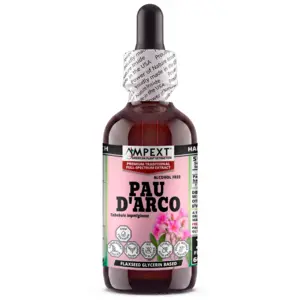
FROM THE AMPEXT RANGE
Pau d'Arco Glycerite (Tabebuia impetiginosa)
Alcohol-free · organic flaxseed glycerin · full-spectrum wildharvested bark · 2 oz
References
- Tabebuia impetiginosa: A Comprehensive Review on Traditional Uses, Phytochemistry, and Immunopharmacological Properties. Molecules, 2020.
- In vitro and in vivo anti-inflammatory effects of taheebo, a water extract from the inner bark of Tabebuia avellanedae. Journal of Ethnopharmacology, 2008.
- Analgesic and anti-inflammatory effects in animal models of an ethanolic extract of Taheebo, the inner bark of Tabebuia avellanedae. Molecular Medicine Reports, 2012.
- The medicinal plant Tabebuia impetiginosa potently reduces pro-inflammatory cytokine responses in primary human lymphocytes. Scientific Reports, 2021.
- Inhibitory effects of Tabebuia impetiginosa inner bark extract on platelet aggregation and vascular smooth muscle cell proliferation through suppressions of arachidonic acid liberation and ERK1/2 MAPK activation. Journal of Ethnopharmacology, 2006.
These statements have not been evaluated by the Food and Drug Administration. This product is not intended to diagnose, treat, cure or prevent any disease. The information in this article is provided for educational purposes only and is not medical advice; consult a qualified healthcare provider before starting any new supplement, especially if you are pregnant, nursing, taking medication, or have an underlying health condition.
Related Products
Leave a comment